
|
    |
|
|
|


SEVENTY YEARS OF KERALA NATANAM by G Vinodini, Trivandrum e-mail: vinodinigopinathsasimohan@gmail.com Dec 2002  Guru Gopinath and Thankamani The year was 1931. On a chilly evening12th December, a large audience had assembled in the Opera house at Bombay. A little after 6.30 pm, the curtain went up. There stood Lord Krishna on the stage, spreading warmth and brilliance!! Adorned in a bright yellow dress - peethaambaram - with an ornate headgear having colourful peacock feathers, the vanamaala, pearl and gold necklaces, anklets and bracelets adding to the beauty. Lord Krishna stood holding the gesture of the flute in his hands and his legs were crossed. The audience were spell bound. Could it be...a painting that had come alive on the stage?! The soothing raga Bilahari played on the flute in the background, filled the silence. There was a loud applause from the onlookers. A bejeweled and coy Radha entered the stage with graceful movements. She danced to the famous keerthana of Deekshithar "Baala gopaalayaasumaam...." 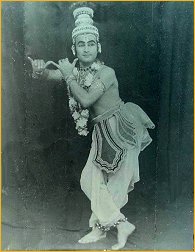 Guruji as Sreekrishna Now it was Krishna's turn. The still figure of Lord Krishna had transformed. His steps, movements, gestures, postures and abhinaya were all blended wonderfully with the padam from Geetha Govindam " kisalaya......". This was followed by a kummi 'Devaadi Devane...". The curtain went down amidst thunderous applause from the viewers. The audience in the Opera house were enthralled and they had good reason too. They saw the maiden performance of an experimental form of dance, an epoch in the history of Indian Dancing. A new style of dance 'Kathakali Natanam' (later known as 'Kerala Natanam') was staged. Guru Gopinath, a youth of twenty three, enacted Lord Krishna and American dancer Ragini Devi (Esther Sherman) was Radha. This novel dance style, classical in nature and modern in approach, has now completed 70 years of its existence. Signal service to Kerala and Kathakali The following year-1932, witnessed the grooming of Kerala Natanam. The experience at the Bombay Opera house inspired Guru Gopinath and Ragini Devi, to nourish this innovative style into a well-defined dance form. Kerala Natanam was put in a theoretical and practical framework. Guru Gopinath had choreographed novel items with Kathakali techniques in tune with the themes and ideas of modern theatre as suggested by Ragini Devi. Kerala Natanam as a new form of dance began gaining awareness and appreciation. Performances were held in many cities of India including Dhaka (now in Bangladesh). These dancers were invited to many universities for lecture demonstrations, which invoked widespread interest and knowledge of Kathakali, While Ragini Devi talked on Kathakali dance, Guru Gopinath presented the Navarasas and the Gesture language. The fruitful result of presenting Kerala Natanam was that Kathakali was brought to light from anonymity and obscurity. Madam Maneka, a Kathak exponent, included Guru Krishnan Kutty - a Kathakali artist - in her troupe and Uday Shankar invited Madhavan, a student of the first batch of Kathakali at Kalamandalam, to join his troupe. Kathakali evoked the interests of persons like Ram Gopal from Bangalore, Sunalini Devi, youngest sister of Sarojini Naidu, Krishnahatti Singh, Shanti Dev Ghosh who came down to Kerala to the little village of Cheruthuruthi in Trichur where Kerala Kalamandalam, the institution for Kathakali training was functioning. Tagore's appreciation "Those of us, who belong to northern India have lost the memory of pure Indian classical dance. We now experienced the thrill of delight at the exhibition of dancing by Srijith Gopinath in association with his partner, Ragini Devi. I felt grateful at the assurance it has brought to us that this ancient art is still a living tradition in India, with its varied grace and vigour and subtleties of dramatic expression". These were the most valued words of appreciation given to the dance style 'Kerala Natanam' by the great poet and cultural reformer Rabindranath Tagore, after viewing the performance of the Gopinath-Ragini Devi team, at Viswabharathi in January 1935 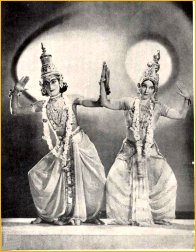 Keralanatanam in 1932 Laksminaraayana Dance by Ragini Devi and Gopinath Though Ragini Devi was instrumental for mooting the idea of short classical dance performances derived from the traditional Kerala dance or dramaturgy known as Kathakali, it was Guru Gopinath and his wife and dance partner Thankamani Gopinath, who groomed it as a classical style of dancing having its own style, identity and beauty. Ragini Devi later lost interest in performances and withdrew from the stage. But Guru Gopinath took this as his mission and completely departed from the orthodox Kathakali to concentrate on Kerala Natanam. 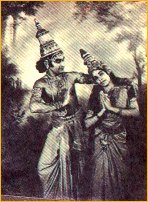
Guru Gopinath and Thankamani Gopinath in Radhaa Krishna Dance Thus a new classical dance form or an entirely new school of dancing was innovated, evolved and systematised, under the leadership of Guruji But he never tried to renovate Kathakali and never claimed his new style a renovation or modification of Kathakali. Kathakali practice course and syllabus reduced By developing a syllabus and training schedule for Kerala Natanam, Guru Gopinath inadvertently, was doing a Herculean task of reducing the twelve year rigid training course and syllabus of traditional Kathakali which was almost untouched for many decades. Only a genius like him could do such a scientific reduction of training period from 12 years to 6 years without compromising its classical, theoretical and practical basics. That is why N V Krishna Warrier, editor, literary person and art critic, placed Guru Gopinath in the group of great achaaryas, whose names were to be primarily revered by Kathakali artists and students. It is saddening that Guruji, Thankamani and their notable disciples are no more. Kesavadas, Guru Chandrasekharan, PTK Menon, Balakrishna Menon, Dancer Thankappan, Lalitha and Ragini of the famous Travancore sisters, all passed away. Guru Gopalakrishnan of Kodungallor, dancer Chellappan and Bhavani of Kottayam, Prof Sankaran Kutty of Trivandrum are among the old disciples living now. Definition Guru Gopinath has defined Kerala Natanam in the foreword of his book 'Natanakairali' as follows: "Kerala Natanam or Kerala Dance is a novel art form evolved from Kathakali and is comprised of nrutha (absolute or pure dance) nritya (dance with music and gesticulations) and natya (dramaturgy) and aamgika (body gestures), vaachika (verbal), aahaarya (costumes and make up) saatvika (of temperaments and involuntary status) abhinaya (acting), in accordance with the taala mela (rhythm) order of the percussion instruments used in Kerala." Kerala Natanam is comprised of Nrutha, Nritya and Natya based on traditional Kathakali, without detracting from its basic tenets but has some of its complex involutions and intricacies. Though it has originated or evolved from Kathakali, it is neither Kathakali nor an attempt to reform or redefine it. In simple words Kerala Natanam is a classical dance following rudiments of 'Naatyasastra" and practicing basics of Kathakali techniques. * It is a classical dance suited for both men and women. It is not confined to men alone as Kathakali was. * It is ideal for solo, duet and group performances and is designed for dramaturgy - Nataka Natanam and ballets. * It is universal because it is stylised and choreographed with a universal audience in mind. It is more lokadharmi in approach without deviating from the classicism. * It was this dance, which made dancing popular, communicative and enjoyable to masses. * It needs comparatively a shorter period for learning and needs no body massage or 'uzhichil' as required in Kathakali training. Differences from Kathakali Guruji distilled the essential elements of Kathakali and coalesced them into his own style of dance, perfectly blending the three constituents of 'Touryatrikam', namely Geetam (song), Vadyam (instruments) and Nrtyam (dance). He took the fundamentals of aangikabhinaya in Kathakali in toto while only adapting some of the components of aaharya, vaachika and saathvika abhinaya to suit the needs of modernisation, synchronisation, sophistication and stylization and to reach his system of dance to the people at large, including the uninitiated and the novice as also the connoisseur. The footwork of Kathakali, which did not have much variety, was made into graceful movements. The Mudras or hand gestures from the treatise, 'Hasta Lakshana Deepika' and the Teerumanams and Kalasams, as used in Kathakali, were accepted almost in their entirety in Kerala Natanam. The 'Abhinayam' of Kathakali was retained in all its glory. Most of the pure dance items like Rangapooja, sari dance and Kummi and the dance-drama episodes and situations in his repertoire like Vamana- Mahabali, Siva-Parvati, Bhasmasura-Mohini, Sundopassunda-Tilottama, Sitapaharanam and Gitopaddesam, which won tremendous national and international popular acclaim and rave reviews by aesthetes and art critics, were culled out from well-known Kathakali plays, chiselled, modified and refined. For the musical accompaniments, Kerala Natanam has completely deviated from Kathakali. It replaced the Sopaana system of musical rendition with the Carnatic style. In addition to Slokams and Padams, it used Malayalam musical compositions and poetry. Well-known songs of various composers, like Swati Thirunal, Erayimman Thampy, Muthuswami Deekshitar and others, along with such ancient works as 'Bhagavad Gita', were selected for choreography. A new orchestra was introduced. Though Kerala percussion instruments like maddalam, chenda, idakka were given prominence in the beginning, Mrudangam and north Indian Instruments like tabla, harmonium, sarangi etc were also used later. Drastic change in costumes In Aharya (costumes and makeup) too, Kerala Natanam had not gone in for the elaborate anklets, facial make-up, the heavy trinkets and the elaborate vestments and skirts of Kathakali but emulated the much simpler modern theatre make-up and costumes and crowns for men and women characters modelled on Gods and Goddesses and Puranic figures as depicted in mural paintings, frescoes, Ravi Varma paintings and temple sculptures. The only exception perhaps was the adoption of the crown of Ravana and other evil characters of Kathakali plays. Since the orthodox make-up and costumes were changed in favour of those found in the paintings of Raja Ravi Varma and others, the common man easily identified mythological characters. The performer adopted makeup and costume suitable to the character, which he/she presented on stage. This freedom is one of the characteristic features of Kerala Natanam. The Kathakali make-up and costumes were very elaborate, costly, and difficult to procure. Persons who learnt Kathakali found it practically impossible to exhibit their talent other than in regular Kathakali programmes. There was a need to remedy this situation, to make it possible for a Kathakali actor to stage a dance programme without the aid of costly make-up and costumes. It was these needs, which Gopinath tried to fulfill. Guru Gopinath firmly resisted the temptation of presenting a mixture of various styles of dance and stuck to the basic Kathakali style, with suitable innovations and modifications. Such innovations were masterly and splendid. The Kekiyattam in Kathakali was beautifully modified and presented as Peacock dance. At a very young age this performance made Guru Gopinath the recipient of 'Veera Srumghala' from the Maharaja of Travancore. Movements of an elephant briefly shown in Kathakali were improved and charmingly brought out in Gajendra Moksham. Scenes from Vana Varnana became Hunter dance. The original slokas of Bhagavad Gita were used in his Gitopadesam with telling effect. Ashta Kalasam was incorporated into a Kambhoji Varnam. Purappadu, with modifications, was adopted as opening item. Guru Gopinath remained faithful to his style and perhaps was the only dancer who retained that style without adulteration, continued teaching, maintained a troupe, and was an active performer till his death. As if destined or as he wished, he died on the stage while performing the role of Dasaratha in his well known 'Ramayanam Ballet" on 9th October 1987 at Fine Arts Hall, Eranakulam. Viswa Kala Kendra The very first institution to teach Kerala Natanam was 'Sree Chithrodaya Narthakaalayam' at Poojappura, Trivandrum established in March 1934.The Maharaja of Travancore, Chithira Thirunal Balarama Varma appointed Guru Gopinath as Palace dancer and gave him facilities and grant for running the institution. 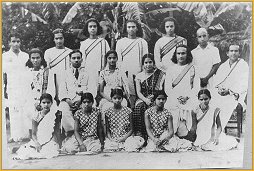 Students of Narthakaalayam at Trivandrum, the first institution to give training in Kerala Natanam In 1946, when Guru Gopinath moved to Chennai, he started a dance school called 'Natana Nikethan' at Gopalapuram. Lots of students from Chennai and from other parts of the country and abroad came to Natana Nikethan for learning Kerala Natanam. In 1959, 'Kerala Kala Kendra was established in New Delhi (which is now known as International Centre for Kathakali), where he was redoing and choreographing the famed 'Ramlila'. In 1962, Viswa Kala Kendra was founded in Ravipuram, Kochi and later shifted to Vattiyoorkkavu, Trivandrum. It is still functioning in Trivandrum offering courses in Kerala Natanam for children, for dance teachers etc Guru Gopinath and Thankamani had choreographed more than 150 dances including many ballets or naataka natanam. Ramayanam Ballet, Naraayaneeyam Ballet, Mahabharatha Ballet, Yesunaadha Vijayam Ballet, Divyanaadam Ballet were the longest among them which are 5 or 6 hours long employing more than 50 people including the musicians and stage managers. Books There are no books, which can be considered as the only one guideline or hand book on Kerala Natanam. No book is written in the name Kerala Natanam. But Guru Gopinath's books on dance explains the basics and theory of Kerala Natanam as he envisaged. The following can be used to know more about Kerala Natanam Ø Abhinaya Prakaashika (English & Sanskrit) Ø Thaalavum Natanavum (Malayalam) Ø Natana Kairali (Malayalam) Ø Kathakali Natanam (Malayalam) Ø Abhinayaamkuram (Malayalam) No fixed dress code for Kerala Natanam Kerala Natanam has assumed importance and become a matter for discussion in recent years. It was included as an item for dance competition for the State School Youth Festival by the Govt. of Kerala. Unfortunately, the definitions and guidelines for Kerala Natanam in youth festival manual was wrong mutilated and contrary to what Guru Gopinath envisaged, practiced and taught. One creative aspect of Kerala Natanam is the freedom it offers to the dancer to use costumes and make up suited to the character presented. As in Bharathanatyam or Mohiniyattam, the dancer's dress code was not fixed. The school youth festival manual insisted on a dress code, which was totally against the spirit and identity of the style. This sparked off a controversy, which has not subsided yet. Even at the time Guruji was living, Kerala Natanam experienced set backs as untrained copycats distorted it by doing away with the classicism it has. So also, dance troupes mushroomed all over Kerala and started presenting ballets under the disguise of Kerala Natanam. Then the Gopinath style of classical dance - Kerala Natanam - slowly started getting diluted and polluted. Now Viswa Kala Kendra Trivandrum, the dance institution founded by Guru Gopinath in 1962, is offering Kerala Natanam courses in typical Gopinath style for both children and dance teachers. G.Vinodini is the youngest daughter of Guru Gopinath and Thankamani. She is Chief Administrative Officer, Viswa Kala Kendra, Trivandrum, which teaches Kerala Natanam. Ragini Devi American lady Ragini Devi was an accomplished exponent of Indian dance. It was the dance programmes organized by her with Guru Gopinath as her partner in early 1930's that gave way to the birth of the new dance form called Kerala Natanam. She is the grandma of the Indian dancer Sukanya and mother of Indrani Rehman. Her real name was Esther Herman. She was born in Michigan. Fascinated by Indian dance, she devoted her life to the classical dances of India and later married an Indian Ramlal Bajpaye. Ragini Devi's career in India was unique in the annals of art. She was among the first to rediscover Kathakali, hidden in obscurity, and present it through out India invoking national and international interest. Gopinath & Ragini Devi's dance troupe has performed in almost all major centers in India in 1932. Her book 'Dance Dialects of India ' is an authentic reference. Raja Ravi Varma Raja Ravi Varma of Kilimannoor Palace, Trivandrum is the world's renowned Indian realistic painter of 19th century. It was he who gave Gods and Goddesses the human face as we see today. His portraits and landscapes brought a new art culture in India. Many of the costumes in Kerala Natanam were copied from his paintings and from the temple sculptures. Hastha Lakshana Deepika Hastha Lakshana Deepika is a text exploring the hand gestures used in dancing. Koodiyaatam, Kathakali and Kerala Natanam follow this as the manual of gestures or 'mudras', which is believed to have been written in Kerala. Hastha Lakshana Deepika recognizes 24 basic hand gestures called ' chatur vimsathi mudras"and nearly 300 combined gestures. The gesture language using Hastha Lakshana Deepika is equivalent to speech. Balarama Bharatham, by the Travancore Maharaja Karthika Thirunaal Balarama Varma, Naatya Saasthra (chapter XII), Abhinaya Darpana of Nandikeswara are the old texts on Hand Gestures. Guru Gopinath Natana Granam Guru Gopinath Natana Granam Society, Vattiyoorkkavu, Trivandrum is promoted by Viswa Kala Kendra and the culture Dept of Govt of Kerala. Viswa Kala Kendra donated 2.03 acres of land to the society to set up a DANCE MUSEUM in memory of its founders Guru Gopinath and Thankamani. Ramlila Ramlila in north India is a drama depicting the story of Lord Sri Rama in connection with the Navarathri/ Dasara festival. The famed Delhi Ramlila is a dance ballet organized by Sri Ram Bharatheeya Kalakendra. It was Guru Gopinath who choreographed and modified it as it is seen today, incorporating different dance styles of India. Ramayanam Ballet Ramayanam Ballet was the production of Viswa Kala Kendra Trivandrum, choreographed by Guru Gopinath. This ballet is deeply indebted to the Kerala Natanam style and has been staged nearly 750 times altogether in Kerala and outside. Thankamani Gopinath Thankamani Gopinath, wife and dance partner of Guru Gopinath was the first student of Mohiniyaattam at Kerala Kalaamandalam. Her service to Mohiniyaatam has no match because she came forward to learn the dance when it had a very bad reputation in the society. Moreover, girls from respectable families were not allowed to learn dance then. She was taught by Mankara Kalyani Amma, an old exponent of Mohiyaattam. Thankamani belongs to the Mulakkal tharavad of Kunnamkulam, Trichur. After her marriage to Guru Gopinath in 1937, she became a Kerala Natanam expert. Actually Thankamani was the winning force behind Guruji as she was responsible for teaching the troupe and managing it. She is also remembered as the heroine of the third Malayalam film 'Prahlaada' directed by K.Subrahmanyam, father of the great dancer Padma Subrahmanyam. 150 dances Some notable Kerala Natanam dances composed by Guru Gopinath and Thankamani. SOLO: Mayoora nrutham (peacock dance) Veda nrutham (hunter dance) Kaaliya Mardhanam Nataraja thandavam Maanava jeevitham Narasinhaavathaaram Purappad Garuda dance Kanduka nrutham Navarasa abhinayam DUET: Radhakrishna dance Shiva-Parvathi dance Saree dance ThodayaM Swarajith Lakshmi- Narayana dance GROUP: Pooja dance Kite dance Paahi parvatha nandini Raasa kreeda Kripa cheyka ambika..vara veenaa Think alum thaliroliyum Kanaka chilanka Nataka Natanam Angulkeeya choodaamani Amudaapaharanam Geethopadesam Bhasmaasura mohini Budha charithan Navakeralam Chandaala bhikshuki Yesu vijayam Sister Niveditha Divya naadam Girija kalyanam Paarijath pushpaapaharanam Vallee parinayam Gandhi sooktam. |
